EN
EN
 AR
AR BG
BG HR
HR CS
CS DA
DA NL
NL FI
FI FR
FR DE
DE EL
EL HI
HI IT
IT JA
JA KO
KO NO
NO PL
PL PT
PT RO
RO RU
RU ES
ES SV
SV IW
IW ID
ID LV
LV LT
LT SR
SR VI
VI SQ
SQ ET
ET HU
HU TH
TH TR
TR FA
FA MS
MS
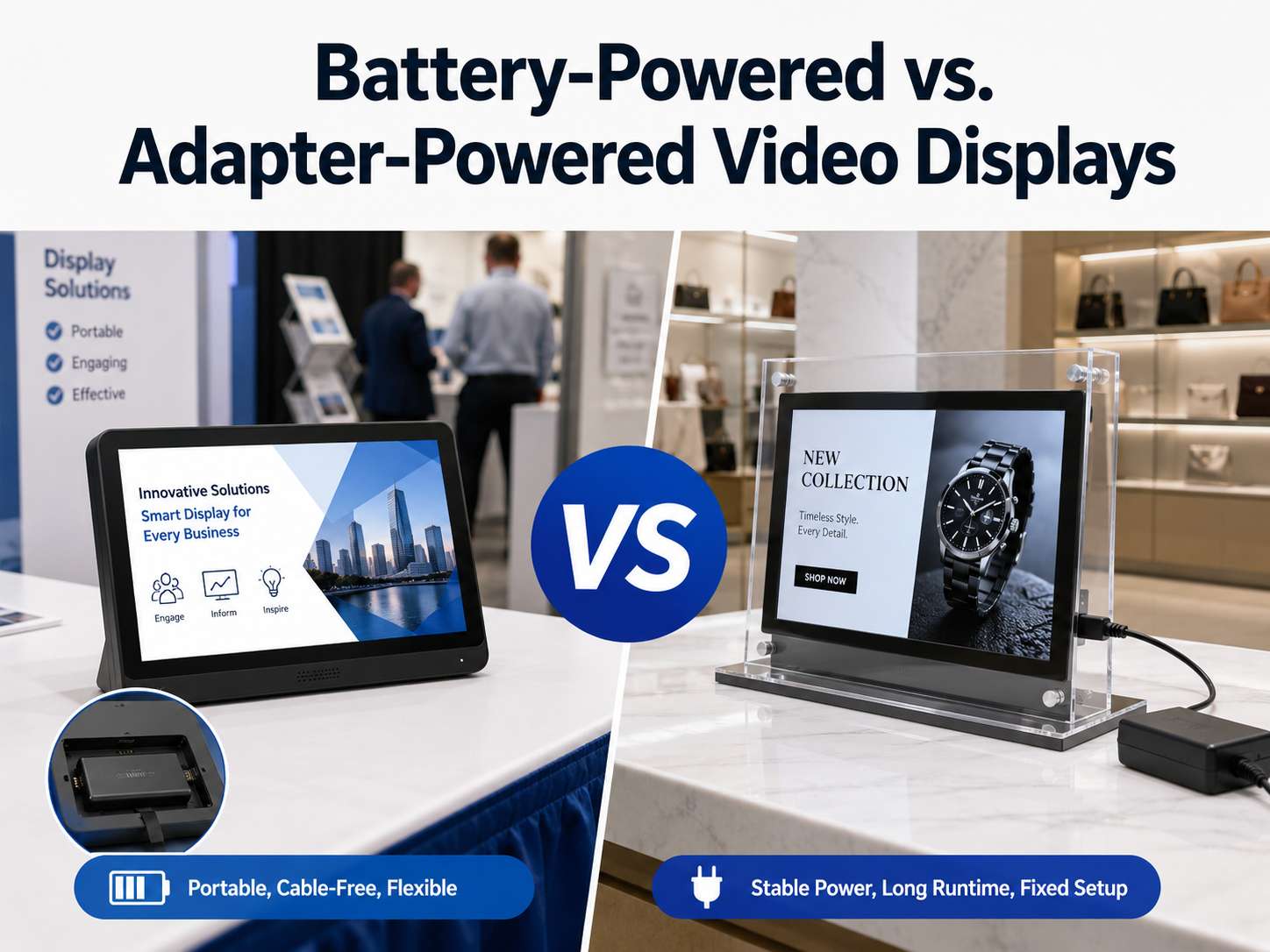
Battery-Powered vs. Adapter-Powered Video Displays: Which Is Right for Your Project? 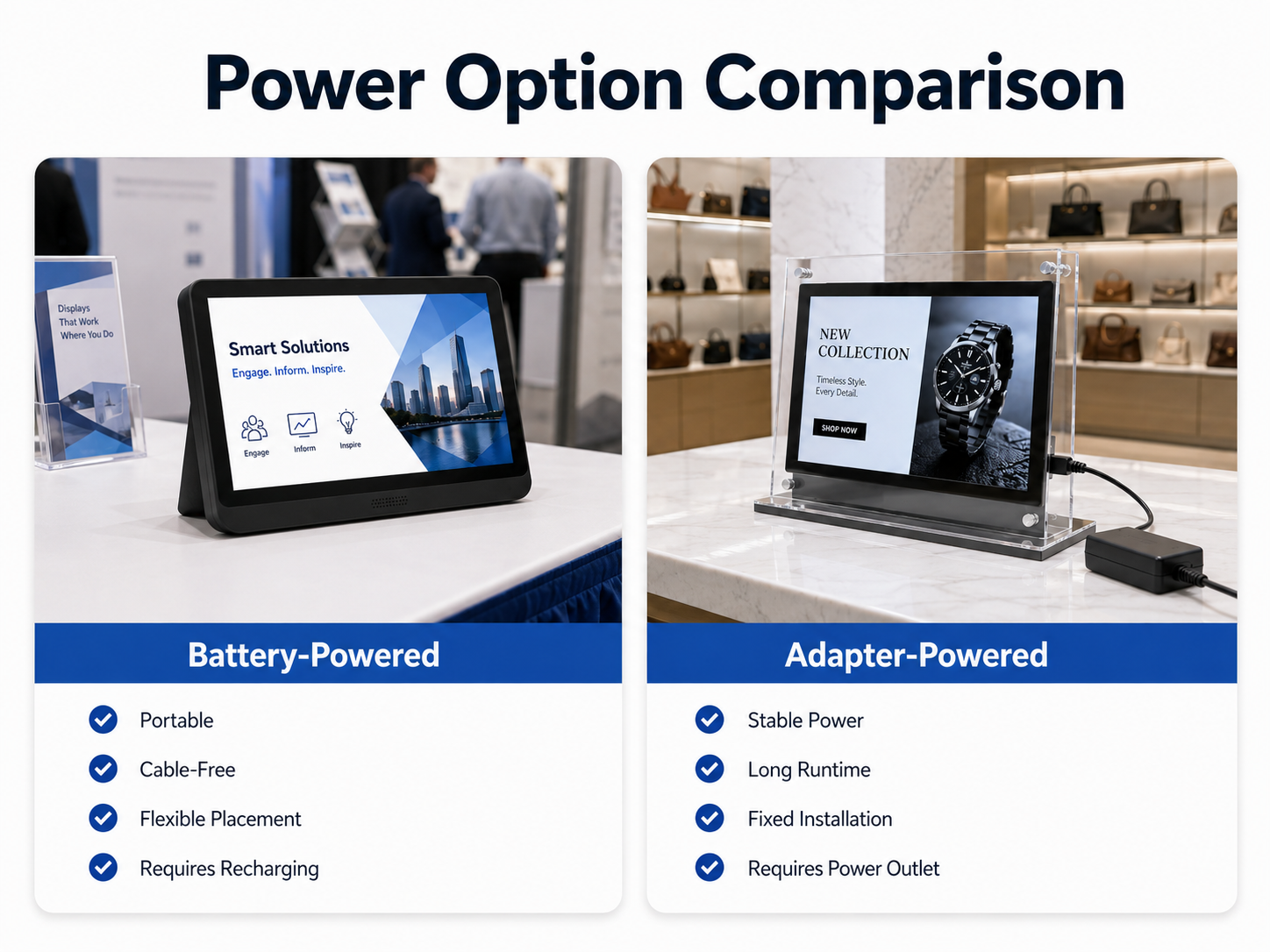
Choosing between a battery-powered vs adapter-powered video display depends on how the display will be used, where it will be installed and how long it needs to operate each day.
Battery-powered displays offer flexibility and portability, while adapter-powered displays are generally better for long-duration or continuous use. For retail displays, exhibitions, counters and branded presentation units, the right choice should be based on operating time, access to power, portability and maintenance requirements.
Start with the Display Environment
Before choosing the power method, define where the display will be used.
Ask these questions first:
- Will the display stay in one fixed location?
- Is a wall socket available nearby?
- Does the display need to move between locations?
- How many hours will it operate each day?
- Will it be used temporarily or for long-term display?
- Does the user need quick setup without visible power cables?
These factors usually determine whether battery or adapter power is more practical.
When Battery-Powered Video Displays Make Sense
Battery-powered displays are suitable when mobility and flexible placement are important.
Typical applications may include:
- Trade shows
- Temporary retail promotions
- Sales presentations
- Portable product displays
- Counter displays without convenient access to power
- Branded presentation boxes
The main advantage is flexibility. The display can be placed on a table, counter or presentation area without depending on a nearby power outlet.
Battery-powered configurations may also help create a cleaner presentation because there is no visible adapter cable during use.
However, buyers should consider charging frequency and expected daily runtime before choosing this option.
When Adapter-Powered Video Displays Are More Suitable
Adapter-powered displays are generally better for applications that require longer or more continuous operation.
Typical applications include:
- Retail counters
- Showrooms
- Reception areas
- Permanent product displays
- Long-duration exhibitions
- Video POS displays
The main advantage is stable operation without relying on battery capacity.
For a display that needs to run for many hours every day, an adapter-powered solution can reduce the need for repeated charging and battery management.
Valsen's video display range includes different power configurations depending on the specific model. For example, the catalogue shows some larger acrylic and counter display models using a DC adapter power supply, while portable brochure and box formats may use built-in batteries. Exact power configuration should be confirmed for the selected model.
Battery vs. Adapter: Quick Comparison
|
Factor |
Battery-Powered |
Adapter-Powered |
|
Portability |
High |
Lower |
|
Access to power outlet |
Not required during use |
Required |
|
Cable-free presentation |
Yes |
No |
|
Long continuous operation |
Limited by battery configuration |
More suitable |
|
Charging management |
Required |
Usually not required during use |
|
Best for temporary setups |
Yes |
Possible |
|
Best for fixed displays |
Possible |
Usually more practical |
Consider Daily Operating Time
Operating time is one of the most important factors.
If the display is only used for short presentations or temporary campaigns, a battery-powered solution may be sufficient.
If the display is expected to run throughout a business day, an adapter-powered model may be more practical.
Buyers should avoid selecting a battery only by capacity numbers. Actual runtime depends on several factors, including:
- Screen size
- Screen brightness
- Audio volume
- Video content
- Battery capacity
- Playback frequency
- Standby behavior
For this reason, battery performance should be confirmed based on the final display configuration rather than assumed from a single specification.
Think About Installation and Cable Management
Power selection also affects how the display is installed.
For retail and exhibition environments, consider:
- Where the power outlet is located
- Whether cables can be hidden
- Whether the display can be moved easily
- Whether the adapter may interfere with the presentation
- Whether the display needs to be mounted or fixed
- Whether staff can recharge the unit when needed
A clean-looking display can lose visual impact if cables are poorly managed. On the other hand, a battery-powered display may create additional maintenance if staff must recharge it frequently.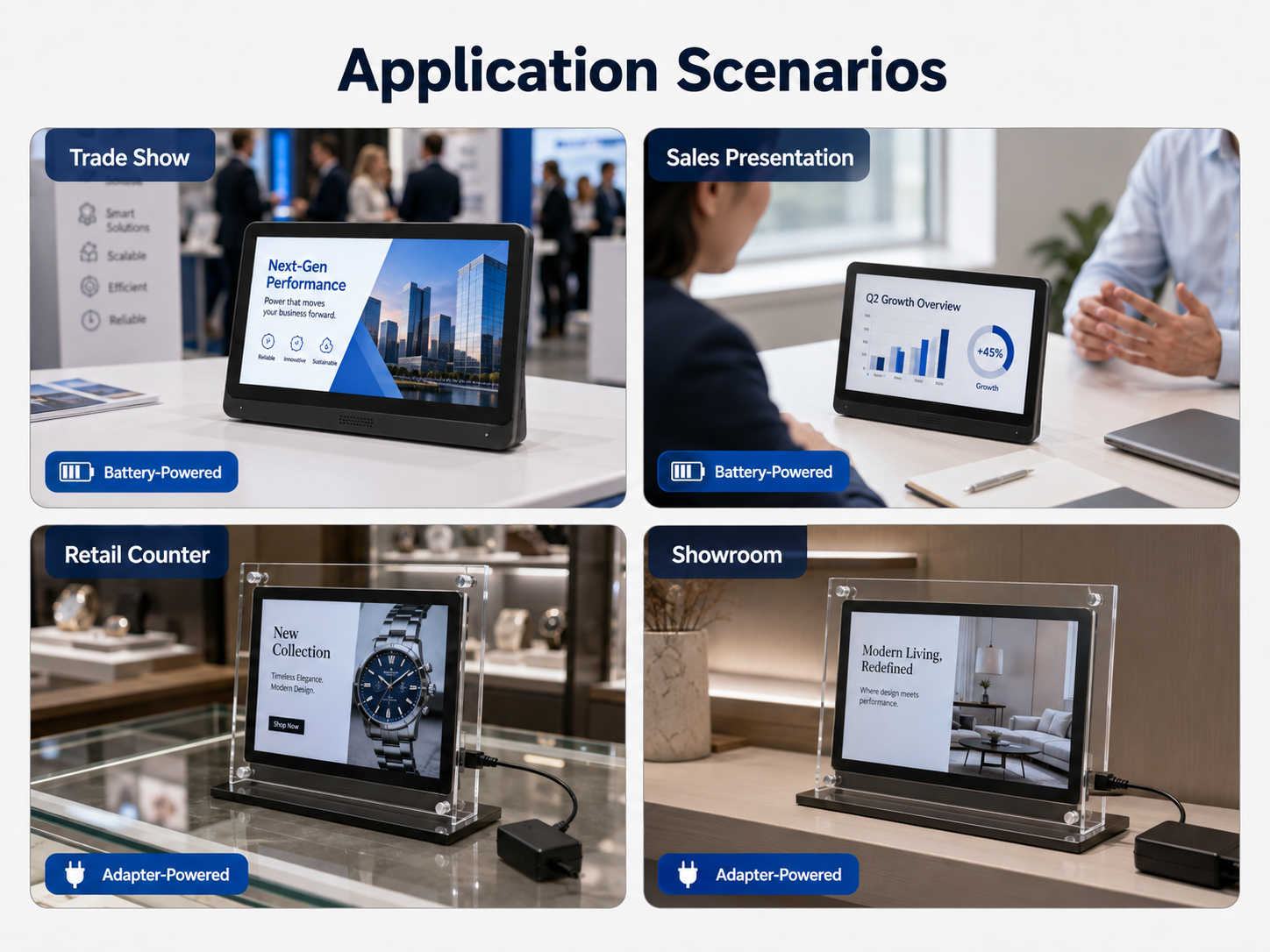
Which Option Works Better for Different Applications?
Trade Shows
Battery power is often practical for temporary displays because it allows flexible placement and reduces cable clutter.
For multi-day exhibitions with long operating hours, an adapter-powered setup may be more convenient if reliable power is available.
Retail Counters
Adapter power is often more suitable for fixed retail displays that need to operate repeatedly throughout the day.
Sales Presentations
Battery-powered formats are usually easier to carry and present without requiring setup near a socket.
Showrooms
For permanent installations, adapter power is generally easier to manage, especially for larger screens or continuous playback.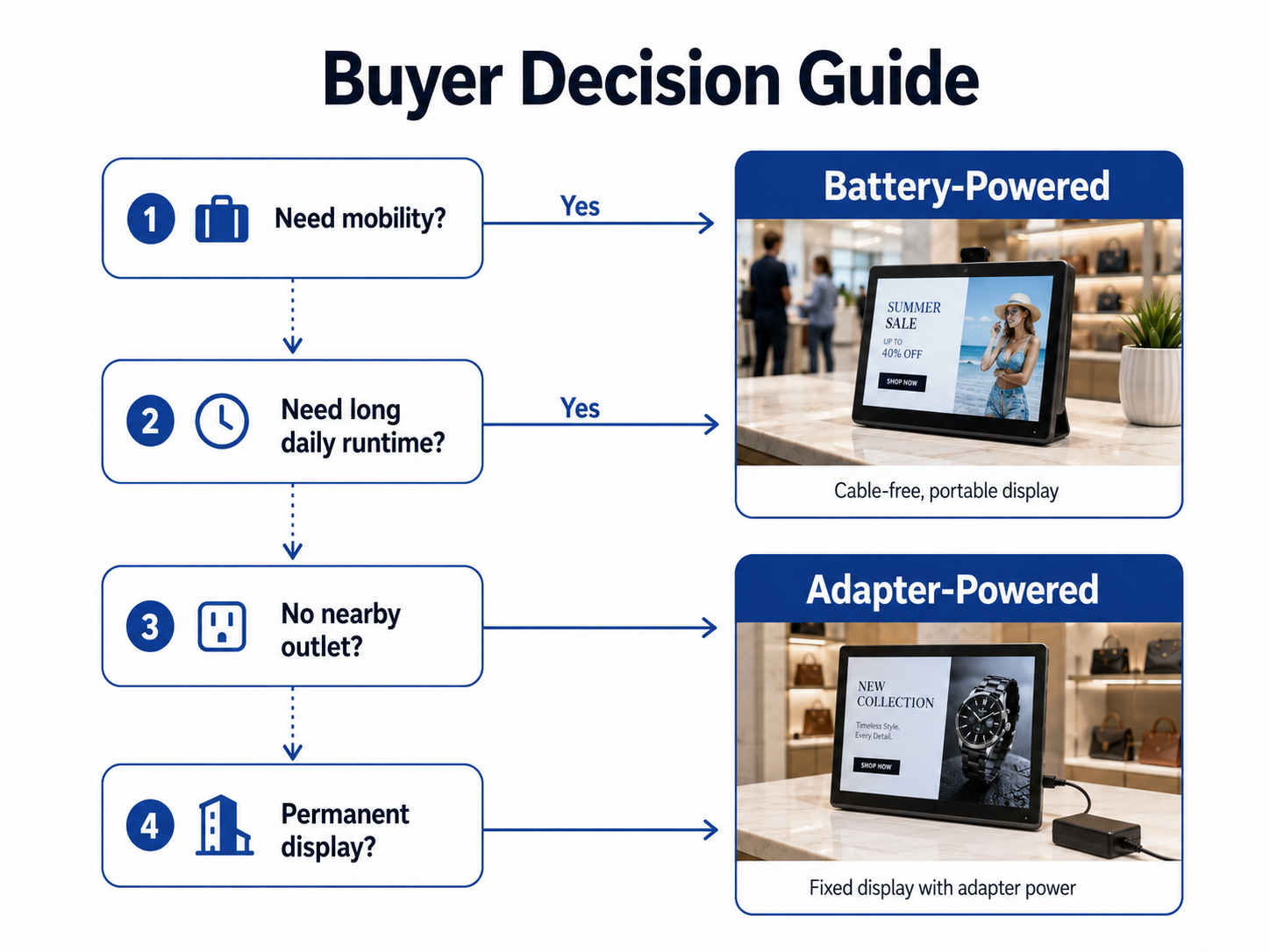
What Should Buyers Confirm Before Ordering?
Before requesting a quotation, prepare:
- Display application
- Screen size
- Installation location
- Expected daily operating time
- Playback frequency
- Access to a power outlet
- Portability requirement
- Whether cables need to be hidden
- Quantity
- Delivery destination
You should also confirm whether the selected model supports battery power, adapter power or both, because power options are not identical across all display formats.
Final Recommendation
Battery-powered video displays are best when portability, flexible placement and cable-free presentation are priorities.
Adapter-powered video displays are more suitable for fixed installations and long-duration operation.
The correct choice should be based on the actual display environment, expected runtime and installation conditions rather than the screen size alone.
Share your display location, expected daily runtime and access to power for a suitable configuration recommendation.
FAQ
Are battery-powered video displays suitable for retail use?
Yes, especially for temporary promotions or locations without convenient power access. For long daily operating hours, adapter power may be easier to manage.
Can a video display support both battery and adapter power?
Some configurations may support different power options, but this depends on the specific model and should be confirmed before development.
Is a larger battery always better?
Not necessarily. A larger battery may increase size, weight and cost. The battery should match the expected runtime and product structure.
Which power option is better for trade shows?
Battery power is useful for flexible, cable-free setups, while adapter power can be better for long exhibition days when a reliable power source is available.
Table of Contents
- Start with the Display Environment
- When Battery-Powered Video Displays Make Sense
- When Adapter-Powered Video Displays Are More Suitable
- Consider Daily Operating Time
- Think About Installation and Cable Management
- Which Option Works Better for Different Applications?
- What Should Buyers Confirm Before Ordering?
- Final Recommendation
- FAQ