EN
EN
 AR
AR BG
BG HR
HR CS
CS DA
DA NL
NL FI
FI FR
FR DE
DE EL
EL HI
HI IT
IT JA
JA KO
KO NO
NO PL
PL PT
PT RO
RO RU
RU ES
ES SV
SV IW
IW ID
ID LV
LV LT
LT SR
SR VI
VI SQ
SQ ET
ET HU
HU TH
TH TR
TR FA
FA MS
MS
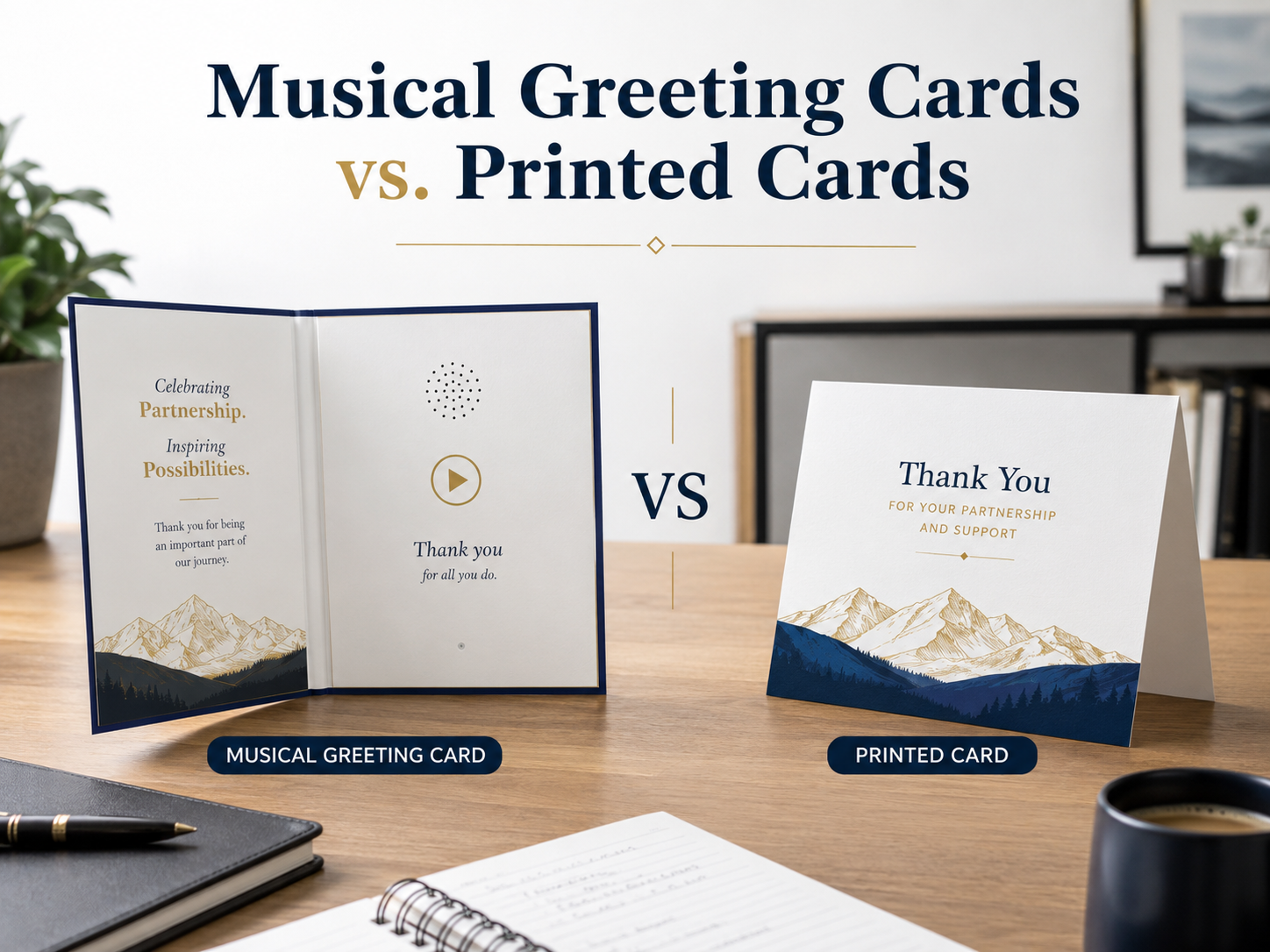
Musical Greeting Cards vs. Standard Printed Cards for Corporate Campaigns
Choosing between musical greeting cards vs printed cards depends on what the campaign needs to achieve.
A standard printed card is often the better choice for simple communication, broad distribution and tighter budgets. A musical greeting card becomes more useful when sound itself adds meaning to the message — for example, a branded voice message, event theme, seasonal greeting or memorable reveal.
For corporate marketing teams, event agencies and greeting card companies, the right decision should be based on campaign objective, message complexity, recipient environment, budget and project timing.
Start with the Campaign Objective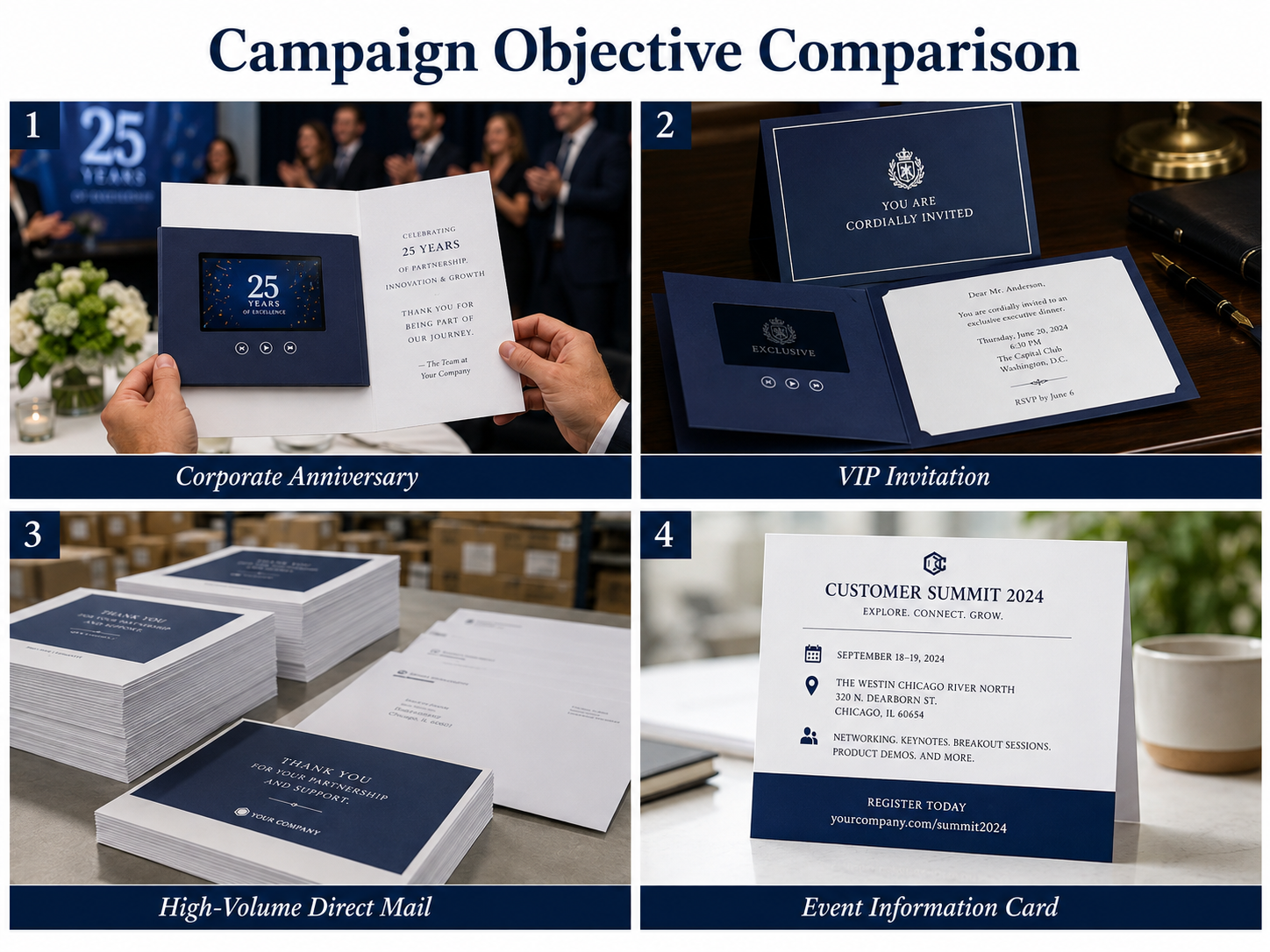
The first question is not “Which card is more impressive?”
It is:
What should the recipient feel, understand or do after opening the card?
A standard printed card works well when the purpose is:
- Sharing a concise thank-you message
- Delivering event information
- Sending invitations at scale
- Supporting a direct-mail campaign
- Communicating a short corporate message
A musical greeting card may be more appropriate when the campaign needs:
- A stronger reveal moment
- A recorded voice message
- Music linked to an event or celebration
- A sound-led brand experience
- A more memorable premium presentation
The audio should support the campaign goal rather than exist only as a novelty.
Compare Message Complexity
Printed cards are highly effective when the message can be understood quickly through text and graphics.
They are suitable for:
- Event dates
- QR codes
- Contact information
- Brand messages
- Promotional offers
- Short seasonal greetings
Musical cards are more useful when the message benefits from timing, voice, sound or emotional tone.
For example, a short spoken introduction can communicate personality in a way that printed text cannot. A music track can also support a campaign theme or celebration.
However, more complex messages are not automatically better. If the audio is too long or unnecessary, it may make the experience feel less focused.
Consider the Emotional Role of Sound
Sound can create an additional layer of communication.
A musical greeting card may be suitable for:
- Corporate anniversaries
- Product launch invitations
- VIP client gifts
- Holiday campaigns
- Employee recognition
- Event invitations
- Brand storytelling
The value comes from combining print and audio into one coordinated experience.
Valsen’s interactive greeting product range includes musical greeting cards, sound modules, light-up cards and related audio components that can be integrated into printed products. Exact audio duration, trigger method and electronic configuration should be confirmed according to the specific project.
Compare Budget and Unit Complexity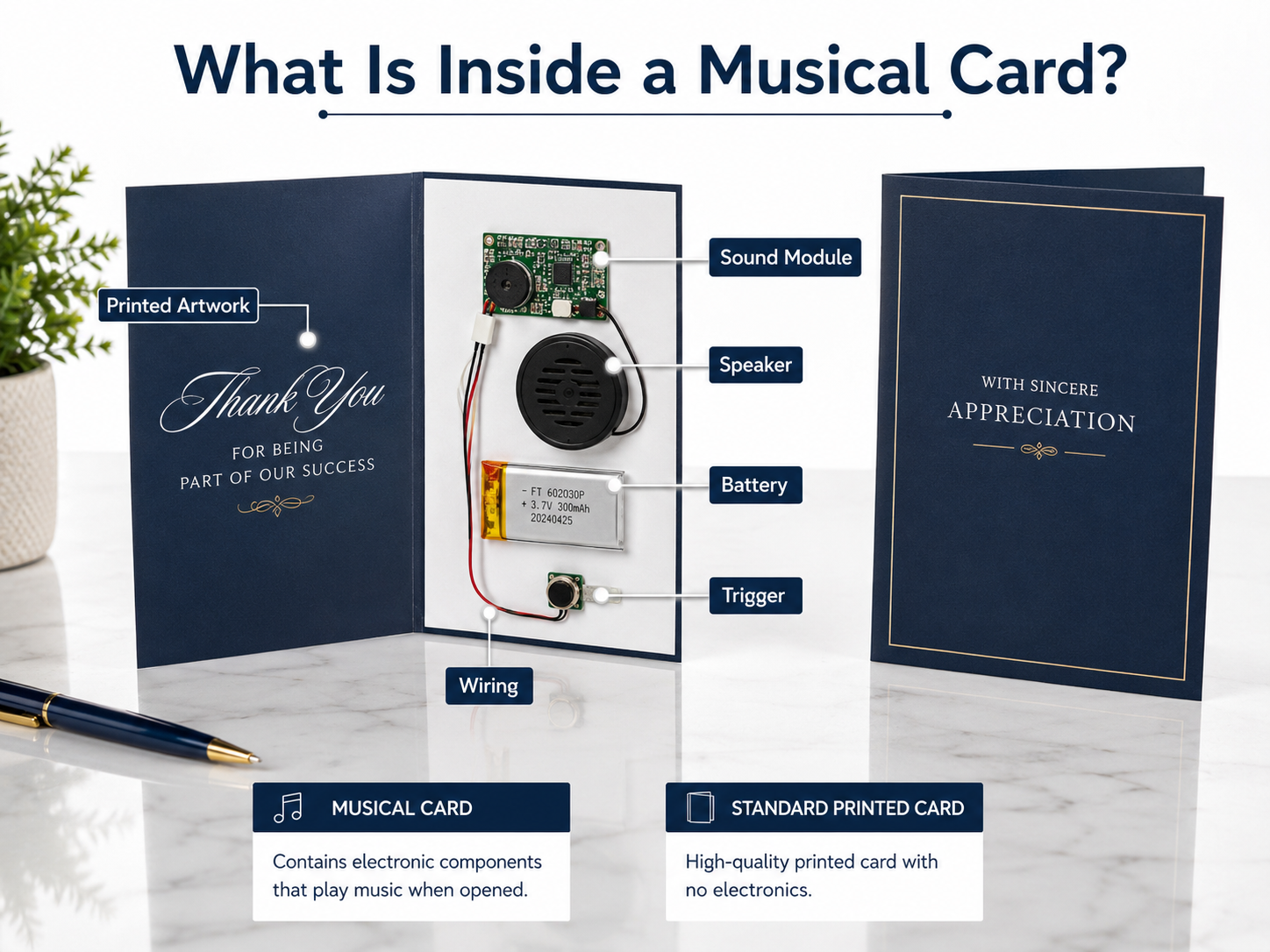
Standard printed cards are usually simpler in structure and production.
A musical card adds:
- Audio module
- Speaker
- Battery
- Trigger mechanism
- Additional assembly
- Audio loading
- Functional testing
These extra components increase project complexity and usually increase unit cost.
For a broad campaign where the message is simple and volume is high, a standard printed card may provide better value.
For a smaller, higher-value recipient group, the additional cost of an audio card may be justified if sound plays a meaningful role in the experience.
Think About Mailing and Transportation
Printed cards are generally thinner, lighter and easier to mail.
Musical greeting cards contain electronic components, so buyers should consider:
- Card thickness
- Final packed weight
- Protective packaging
- Speaker and battery protection
- International shipping requirements
- Mailing format
A musical card may still be suitable for direct mail, but packaging and transportation should be considered at the design stage rather than after production.
If the campaign requires very large-scale postal distribution, a simple printed format may be easier to manage.
Confirm Audio Rights Before Production
One important difference between printed and musical cards is audio copyright.
If the card includes:
- Commercial music
- Branded sound effects
- Celebrity voices
- Recorded speeches
- Third-party audio
the buyer should confirm that the required rights or permissions are available.
Using custom voice recordings, licensed music or original audio can help reduce copyright risk.
Audio files should be finalized and approved before mass production whenever possible.
Choose a Trigger That Matches the Experience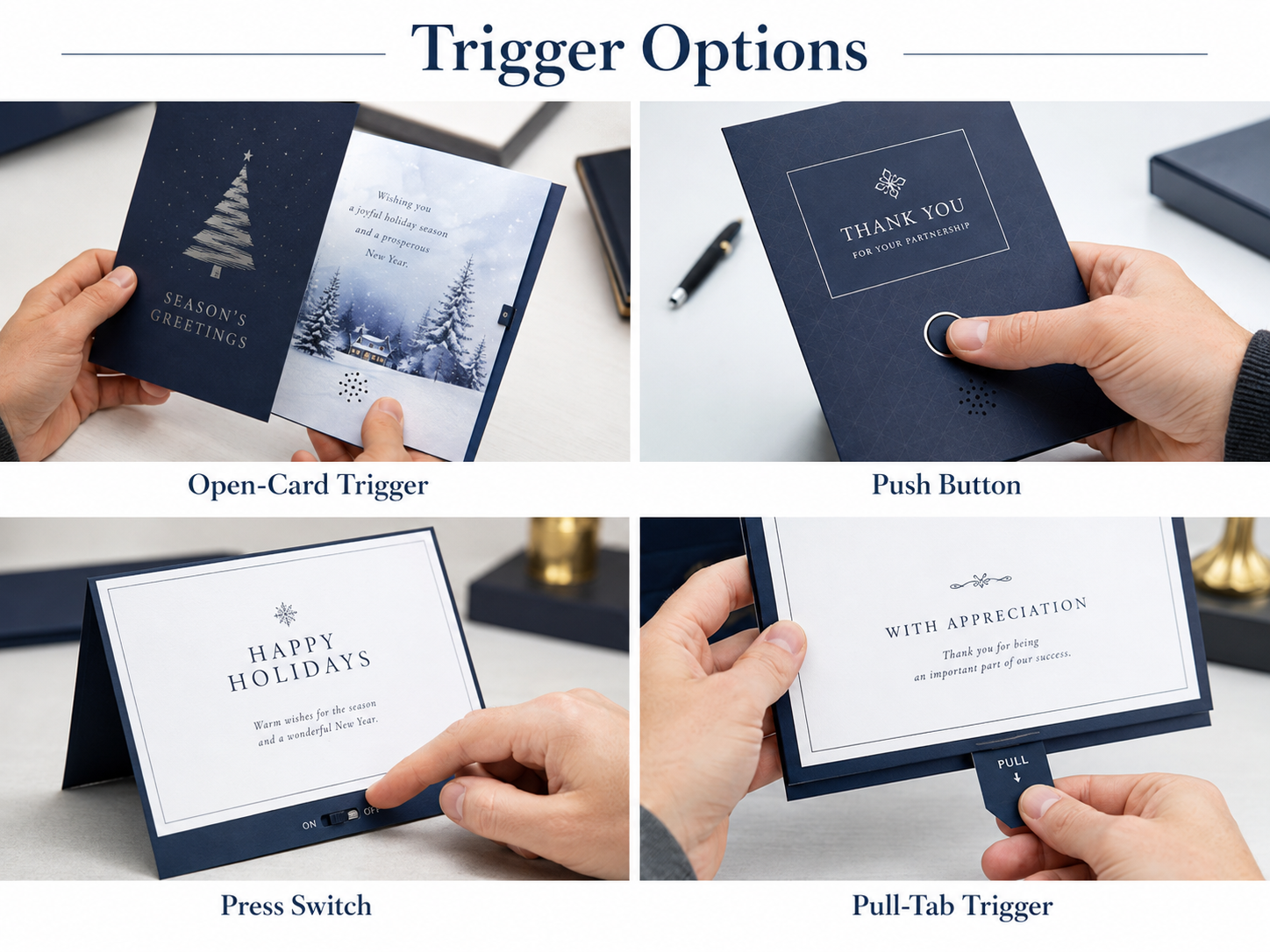
Musical greeting cards can use different trigger methods depending on the structure.
Common options may include:
- Open-card trigger
- Push button
- Press switch
- Pull-tab trigger
An open-card trigger works well when the audio should begin immediately as part of the reveal.
A button may be more suitable when the recipient should decide when to play the message.
The trigger method affects both the internal electronic layout and the way the recipient interacts with the card, so it should be confirmed early in development.
Consider the Recipient Environment
A musical card may be effective in a private office, home or controlled meeting environment.
It may be less suitable in situations where:
- The recipient is in a very quiet workplace
- Several cards may be opened at the same time
- The campaign is distributed in crowded public areas
- Audio could interrupt the surrounding environment
A standard printed card has no such limitation.
For this reason, the intended use environment should be part of the product decision.
Think About Retention Value
Both formats can be designed to encourage recipients to keep them.
Printed cards can achieve this through:
- Strong artwork
- Premium paper
- Special finishing
- Useful information
- Personalization
Musical cards can add another reason to keep the piece because the recipient can replay the audio.
However, retention value still depends on the quality of the design and message. Adding sound to a weak concept does not automatically make the card more valuable.
Compare Project Timing
A standard printed card generally has a simpler development process.
A musical greeting card requires additional confirmation, including:
-
Artwork
-
Audio file
-
Audio duration
-
Trigger method
-
Module size
-
Speaker position
-
Battery arrangement
-
Sample testing
- Final assembly
This means musical cards should normally be planned earlier, especially when a campaign has a fixed event or holiday date.
The sample should be tested as a complete product, including audio, trigger, print and assembly.
Musical Greeting Card vs. Printed Card: Quick Comparison
|
Decision Factor |
Musical Greeting Card |
Standard Printed Card |
|
Emotional expression |
Strong when audio adds meaning |
Depends on copy and design |
|
Message format |
Print + voice/music/sound |
Print only |
|
Budget |
Higher project complexity |
Simpler and generally lower |
|
Mailing |
Requires more planning |
Easier for large-scale mail |
|
Audio rights |
Must be confirmed |
Not applicable |
|
Trigger options |
Open, button, press or other configurations |
Not applicable |
|
Quiet environments |
May need consideration |
No audio concern |
|
Development time |
Longer |
Usually shorter |
|
Premium campaigns |
Strong fit |
Also suitable with premium finishing |
|
Large-volume simple campaigns |
Possible, but may be unnecessary |
Often more practical |
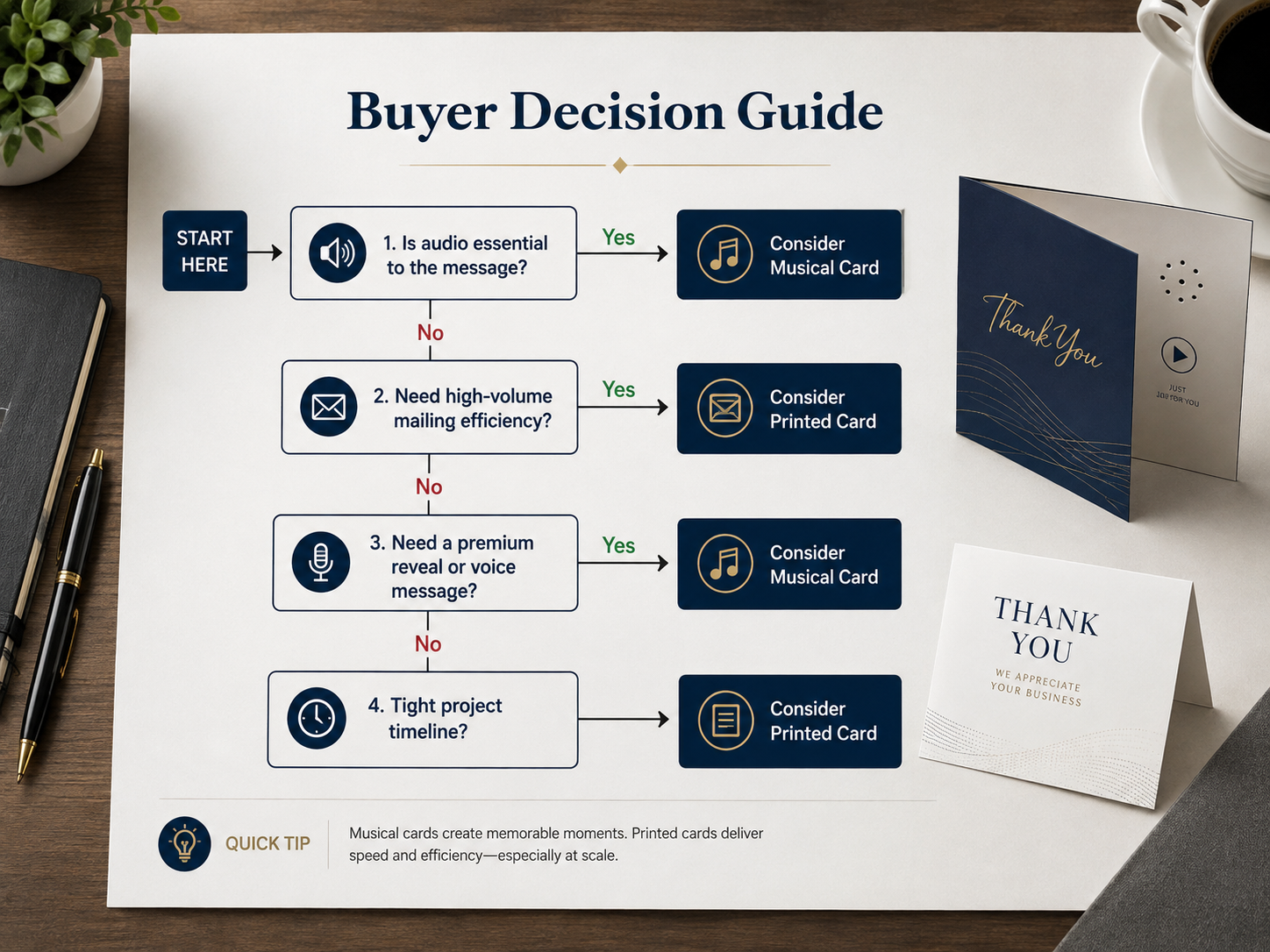 Which Format Should You Choose?
Choose a standard printed card when:
- The message is simple
- Distribution volume is high
- Mailing efficiency is important
- Budget is tightly controlled
- Audio does not add meaningful value
Choose a musical greeting card when:
- Sound is part of the campaign concept
- A voice or music message adds emotional value
- The recipient group is more targeted
- The opening experience matters
- The project allows enough time for sampling and testing
Final Recommendation
The best format is the one that supports the communication goal with the least unnecessary complexity.
Printed cards remain a practical choice for clear, scalable corporate communication. Musical greeting cards are better when sound genuinely strengthens the campaign message or creates a more memorable interaction.
Share your campaign objective, quantity and message format to determine whether an audio card is suitable.
FAQ
Are musical greeting cards suitable for corporate campaigns?
Yes. They can be used for invitations, anniversaries, holiday campaigns, VIP gifting and other projects where sound supports the message.
Are printed cards better for large-volume campaigns?
They can be more practical when the message is simple, mailing efficiency matters and additional electronic functionality is not required.
Can a musical greeting card play a custom voice recording?
Custom audio may be possible depending on the selected sound module and configuration. The audio file, duration and playback logic should be confirmed before development.
What should be approved before producing a musical greeting card?
Confirm the artwork, audio file, audio duration, trigger method, module layout, speaker position and complete functional sample before mass production.
Table of Contents
- Start with the Campaign Objective
- Compare Message Complexity
- Consider the Emotional Role of Sound
- Compare Budget and Unit Complexity
- Think About Mailing and Transportation
- Confirm Audio Rights Before Production
- Choose a Trigger That Matches the Experience
- Consider the Recipient Environment
- Think About Retention Value
- Compare Project Timing
- Musical Greeting Card vs. Printed Card: Quick Comparison
- Which Format Should You Choose?
- Final Recommendation
- FAQ